Fort Supply Historic Site
1 / 5
Back to ExploreShop the OkieX Store
History and Culture· Frontier Fort
Highly Recommended
Fort Supply Historic Site
Fort Supply, Oklahoma· Woodward County· Red Carpet Country
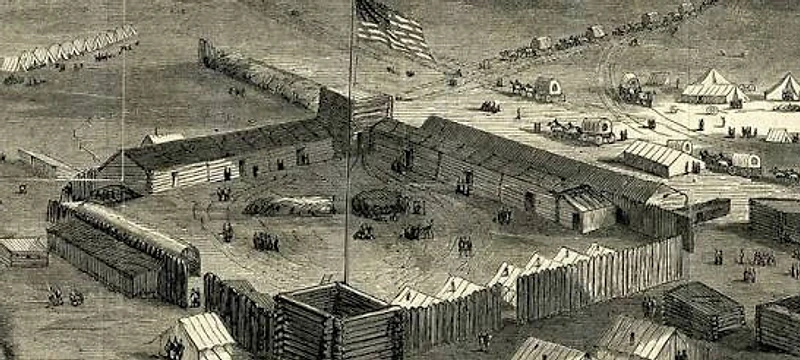
Camp Supply was established in late 1868 for the winter campaign against the Plains Indians in western Indian Territory.
Love exploring Oklahoma?
Shop the OkieX merch — tees, stickers and road-trip gear made for people who take the long way home.
OkieX 1907 Heritage Tee
$23.00 – $31.00
Destination Guide
Fort Supply Historic Site preserves one of Oklahoma’s most significant frontier military posts. Established on November 18, 1868, as Camp of Supply, the post was created as a base for the U.S. Army’s winter campaign on the Southern Plains. Only days after its establishment, Lt. Col. George Armstrong Custer and the 7th U.S. Cavalry departed from Camp Supply on the campaign that culminated in the attack on Cheyenne Chief Black Kettle’s village at the Washita River on November 27, 1868.
For the next quarter century, the post played an important role in the rapidly changing history of Indian Territory. Soldiers stationed here patrolled the Cheyenne and Arapaho Reservation and the Cherokee Outlet, protected travelers and transportation routes, confronted illegal settlers and smugglers, and supported military operations throughout the region. Camp Supply also became the temporary location of the Cheyenne and Arapaho Indian Agency in the early years of the post.
Fort Supply also has an important connection to the Buffalo Soldiers. By 1870, five companies of the African American 10th U.S. Cavalry were stationed at Camp Supply alongside elements of the 3rd Infantry. On June 11, 1870, troops at the post fought Kiowa and Comanche warriors in what became known as the Battle of Camp Supply.
During the Red River War of 1874–75, Camp Supply served as a major supply base for troops operating across the Southern Plains. In December 1878, the Army officially renamed the post Fort Supply. Soldiers later helped police the Cherokee Outlet and participated in events surrounding the opening of Oklahoma lands to non-Native settlement, including the Land Run of 1889 and opening of the Cherokee Outlet in 1893.
The Army closed Fort Supply in September 1894, ending approximately 26 years of military occupation. The property later took on an entirely different role: in 1908, Oklahoma established its first state-operated mental health facility on the former military post, beginning another chapter in the site's history.
Several remarkable pieces of the original fort survive. These include the Ordnance Sergeant's Quarters, Civilian Employee Quarters, Commanding Officer's Quarters, Officers' Quarters and the 1892 Guard House, along with a reconstruction of the original 1868 stockade. The Ordnance Sergeant's and Civilian Employee quarters are particularly unusual examples of picket-style construction, in which vertical logs were used to form the walls. The brick Guard House was the only brick building constructed by the U.S. Army at Fort Supply.
Standing on the open plains of northwestern Oklahoma, Fort Supply offers a tangible connection to a complicated period when the U.S. military, Plains tribes, Buffalo Soldiers, settlers and cattlemen all crossed paths in Indian Territory. The surviving buildings make it possible to see traces of a frontier post that played a role in events ranging from the Washita campaign and Red River War to the opening of Oklahoma Territory.
Location & Contact
1 William S. Key Blvd., Fort Supply, Oklahoma 73841.0
Hours, pricing, and availability may change. We recommend confirming details directly with the destination before traveling.