Cain's Ballroom
1 / 2
Back to ExploreShop the OkieX Store
History and Culture· Music Venue
Verified Visit Must Visit
Cain's Ballroom
Tulsa, Oklahoma· Tulsa County· Green Country
Tulsa's legendary dance hall.
Love exploring Oklahoma?
Shop the OkieX merch — tees, stickers and road-trip gear made for people who take the long way home.
OkieX 1907 Heritage Tee
$23.00 – $31.00
Destination Guide
Cain’s Ballroom is one of Oklahoma’s most important music landmarks and one of the most storied live-music venues in the United States. Located at 423 N. Main Street in Tulsa’s historic Arts District, the distinctive brick building has spent more than a century evolving alongside American music. It has served as an automobile garage, dance academy, Western Swing headquarters, rock-and-roll venue and punk landmark, yet its greatest historical significance comes from its association with Bob Wills and the Texas Playboys. Their years at Cain’s helped establish Tulsa as one of the centers of Western Swing and earned the ballroom its enduring reputation as the “Home of Bob Wills.”
The building dates to 1924 and was originally constructed for the automobile business before Madison W. “Daddy” Cain established a dance academy there around 1930. For years it was known as Cain’s Academy of Dancing or Cain’s Dancing Academy. Inside, one of its defining features was a large spring-loaded maple dance floor arranged in a distinctive concentric pattern. Designed to provide a little give beneath the feet of dancers, the floor became part of the Cain’s experience and remains one of the most recognizable historic features of the ballroom today.
The defining chapter in Cain’s history began on New Year’s Night in 1935, when Bob Wills and the Texas Playboys made their debut at the ballroom. Wills and his musicians were developing a new sound from an extraordinary mixture of musical traditions—country and old-time fiddle music combined with blues, jazz, big-band swing and other influences heard throughout Oklahoma, Texas and the Southwest. That combination became known as Western Swing, and Cain’s became one of the places where the genre truly flourished. From the mid-1930s into the early 1940s, Wills and the Texas Playboys used Tulsa as their home base, performing regularly at Cain’s while radio broadcasts carried their music to listeners far beyond the ballroom. The combination of live performances and radio helped turn Bob Wills into one of the most influential figures in country music and made Cain’s an important landmark in the development of a distinctly Southwestern American sound.
Crowds packed the ballroom to dance while Wills played fiddle, called out encouragement to his musicians and led a band capable of moving from country breakdowns to blues, jazz and swing. Songs such as “San Antonio Rose” and the unmistakably Oklahoma “Take Me Back to Tulsa” became standards, and Wills eventually earned the title “King of Western Swing.” His influence reached well beyond traditional country music, helping shape later generations of country, rock, Americana and roots musicians. Because of that history and the remarkable musicians who passed through the room, Cain’s has sometimes been described as the “Carnegie Hall of Western Swing.”
Unlike many historic music venues, however, Cain’s did not become a museum dedicated to a single era. After quieter years in the middle of the twentieth century, the ballroom was revived as a concert venue in 1977 and began another remarkable chapter. Country, rock, blues, punk, folk and alternative musicians all found their way onto the same stage once occupied by Bob Wills. One of the most famous examples came in 1978, when the Sex Pistols performed at Cain’s during their notorious American tour. The image of an English punk band performing in the former home of Western Swing might seem unlikely, but it perfectly represents the unusual history of Cain’s: the building has continually adapted as American music changed around it.
Over the decades, Cain’s has hosted an extraordinary range of performers. Early country stars and Western Swing musicians were followed by generations of rock, punk, folk, Red Dirt, Americana and alternative artists. Names associated with the venue’s long history range from Hank Williams, Ernest Tubb and Tex Ritter to Leon Russell, J.J. Cale, Willie Nelson, the Sex Pistols and many more. Photographs and memorabilia throughout the ballroom help tell that story, creating the feeling that nearly every generation of American popular music has left something behind here.
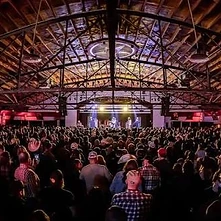
That continuity is what makes Cain’s particularly special. It is not simply a preserved historic building where visitors are asked to imagine what happened decades ago. Cain’s is still a working concert venue. Nearly a century after dancers first began gathering here, crowds continue standing on the historic floor and watching musicians perform beneath the ballroom’s famous neon star. Cain’s Dancing Academy was added to the National Register of Historic Places in 2003, formally recognizing the building’s historic significance, but its importance to Tulsa is just as much cultural as architectural.
Cain’s also represents an important piece of Oklahoma’s larger musical identity. Western Swing emerged from the cultural crossroads of Oklahoma, Texas and the Southwest, where rural Southern music encountered jazz, blues, swing and other musical traditions. Cain’s became one of the places where those influences came together before being carried across the country through recordings, radio and touring musicians. That makes the ballroom more than simply a famous Tulsa concert venue—it is a surviving physical connection to an important chapter in the development of American music.
With so many decades of performances, dancing and late nights inside an old building, Cain’s has naturally accumulated its share of ghost stories as well. Employees, performers and visitors have occasionally reported unexplained footsteps, strange noises, sudden cold spots, shadowy figures and the sensation that someone else is present in otherwise empty areas of the ballroom. Various versions of the folklore connect the unexplained activity with people and musicians from the building’s past. These stories have never been established as historical fact and are better understood as part of the folklore surrounding Cain’s, but they add another interesting layer to a building already filled with nearly a century of memories. At Cain’s, the ghosts—real or imagined—are ultimately secondary to a history that is remarkable enough on its own.
For visitors, the best way to understand Cain’s Ballroom is to actually experience a concert there. Standing on the same historic dance floor where Oklahomans once gathered to hear Bob Wills and the Texas Playboys creates a direct connection between the state’s musical past and present. The performers and styles have changed dramatically—from Western Swing and early country to rock and roll, punk, Red Dirt, indie and modern touring acts—but the room has endured. More than a century after the building was constructed, Cain’s Ballroom is still doing essentially what made it famous in the first place: bringing people together in Tulsa to experience live music.
Location & Contact
423 N Main St, Tulsa, Oklahoma 74103.0
Photo Gallery

Hours, pricing, and availability may change. We recommend confirming details directly with the destination before traveling.